AI promised to simplify our lives. From generating blog posts in minutes to designing images with a single prompt, today’s tools seem endless in their potential. But for many creators, small businesses, and even enterprise teams, the explosion of AI apps has led to a new problem: AI tool fatigue. Instead of streamlining work, the constant juggling of tools can actually increase complexity, cost, and stress.
Explosion of AI Tools
Over the last few years, AI has grown into a fragmented ecosystem of hyper-specialized tools:
Writers & Content Tools: Jasper, Copy.ai, Writesonic, etc.
SEO & Marketing Tools: SEMrush, Surfer, NeuronWriter.
Each tool promises best-in-class features, but the result is that creators often find themselves subscribing to five or more platforms just to get one project out the door.
Hidden Costs of Fragmentation
While each AI tool on its own seems manageable, the real challenges emerge when they’re stacked together.
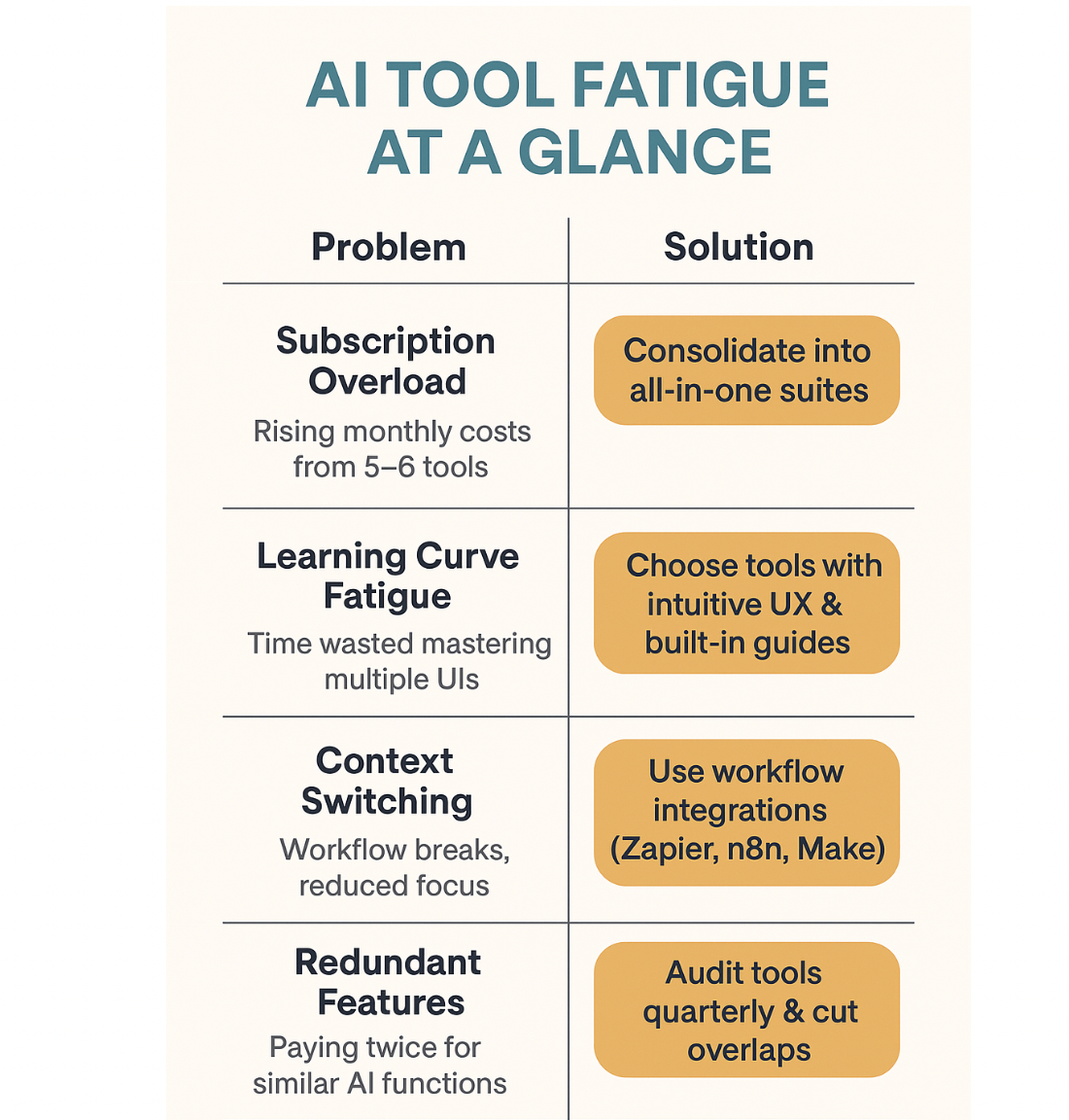
Subscription Overload – Most tools follow a SaaS model, with $10–$50 monthly tiers. Add 5–6 tools, and you’re suddenly spending hundreds of dollars per month.
Learning Curve Fatigue – Switching between interfaces, logins, and workflows drains focus. Each app has its own quirks to master.
Context Switching – Jumping from an AI writer to an SEO optimizer to an AI voice generator creates workflow friction that reduces actual productivity.
Redundancy – Many tools overlap in features (e.g., multiple apps offering AI copywriting), making it unclear which to keep.
The promise of AI efficiency often gets drowned in this noise.
Real-World Spotlight
A small business owner might start with an AI writer, then add design and video tools to build ads. Within six months, they’re juggling six subscriptions and burning more time managing tools than creating content.
A marketing team spends hours syncing outputs between three different AI apps, only to realize that 30% of features overlap.
This fatigue isn’t hypothetical. Gradually, it’s becoming a real operational pain point for creators and companies alike.
Real-World Example: A Marketing Agency’s AI Overload
A mid-sized digital marketing agency subscribed to multiple AI platforms to speed up client deliverables:
Copy.ai for ad copy and blog drafts
Surfer SEO for keyword optimization
Canva Pro for design
Murf AI for voiceovers in client videos
Vidnoz AI for quick explainer videos
Zapier to connect workflows
At first, productivity spiked. But within six months, the team faced:
Costs ballooning to over $700/month in subscriptions
Workflow friction, with staff wasting hours switching between logins and dashboards
Feature redundancy, as Copy.ai and Surfer SEO both offered overlapping content suggestions
Team fatigue, with junior staff struggling to learn and adapt to every platform update
Possible Solutions to AI Fatigue
The industry is slowly responding:
All-in-One Suites: Tools like Notion AI, Wix Studio, and ClickUp are embedding multiple AI functions inside a single platform.
Consolidation: Expect mergers and acquisitions where smaller AI startups are absorbed into bigger ecosystems.
Workflow Integrations: Tools like Zapier, Make, and n8n are being used to stitch multiple AI apps into one smooth process.
Smarter Selection: Businesses are becoming more critical, asking: Do we need five tools, or just two really good ones?
The Bigger Picture
AI fatigue mirrors what happened in the early days of SaaS: too many tools, too little consolidation. Over time, the winners were those who built ecosystems (Google Workspace, Microsoft 365) while niche specialists carved out smaller, loyal markets.
The same pattern is now emerging in AI. The battle isn’t over who has the flashiest feature. It’s actually about who can own the workflow without exhausting the user.
Final Thought: The Future of AI Tools
AI was supposed to remove friction, not add it. Yet in 2025, the irony is clear: the biggest problem may not be finding an AI tool but it’s surviving the overload of them.
The next phase of the AI revolution won’t be about more tools. It will be about better orchestration, fewer subscriptions, and platforms that truly simplify work. Until then, AI tool fatigue might be the hidden cost of living in the AI age.